


Boca Raton Townhomes and Villas
See available townhomes and villas ↓
Boca Raton townhomes and villas guide
If you are searching for townhomes, townhouses or villas in Boca Raton, this page is a straightforward guide to how those labels are used, how they differ from condominiums and single-family homes, and where attached homes are found east and west of I-95. Lehmann Realty Inc, based in Delray Beach, works with buyers and sellers throughout Boca Raton. For a wider look at the city, start with our Boca Raton area page.
One important distinction up front: a Boca Raton mailing address does not necessarily mean the property is inside the City of Boca Raton. The City’s own residency map is the place to check whether an address is in the city, in the Greater Boca Raton Beach and Park District, or in unincorporated Palm Beach County. Services, permits and association rules can differ, so confirm the jurisdiction for the exact address before you buy.
Featured Boca Raton Villa Listing
A current Lehmann Realty Inc listing in Boca Raton Hills, Section 2.
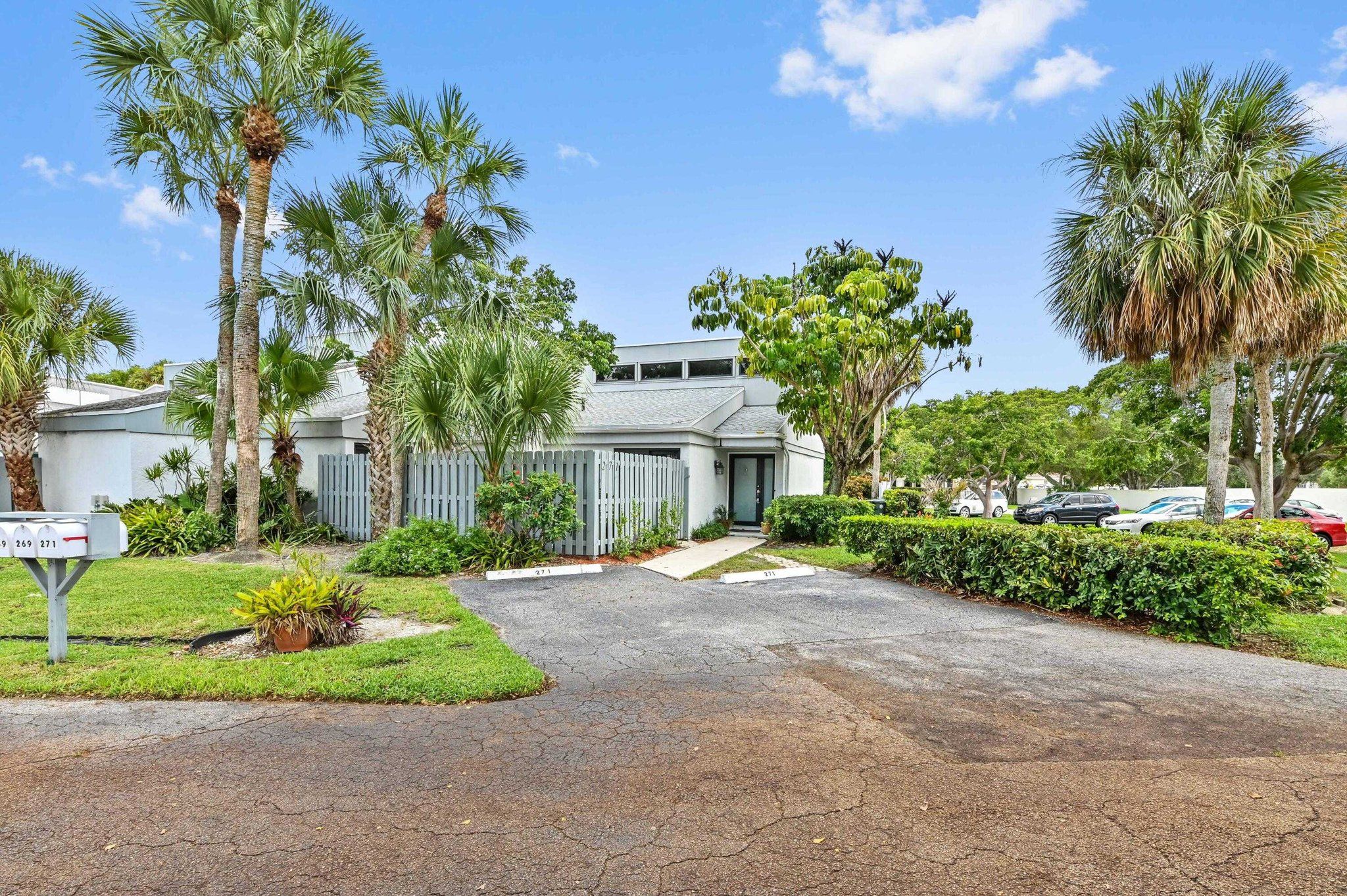
271 NW 15th Street, Boca Raton, FL 33432
$449,900
List price as of November 11, 2026. Price, status and availability can change; see the full listing for current details.
2 beds | 2 baths | 1,522 sq ft
MLS# R11157843 | Villa, one story, built 1978
Key features: Corner-unit villa in the recorded subdivision Boca Raton Hills Sec. 2, inside the City of Boca Raton. The listing remarks describe a large den that works as a third bedroom, two patios, two assigned parking spaces, an updated roof, air conditioning, and impact-resistant windows and doors, plus a tankless water heater, an upgraded electrical panel, and an insulated 800-square-foot attic. The MLS lists a $525 monthly association fee for this property and states that the fee includes sewer, trash and water. The remarks also state that the association covers insurance for the exterior, as well as lawn, water and sewer. Confirm current fees, inclusions and insurance in the association documents.
Listing information from BeachesMLS, Inc. (MLS# R11157843), deemed reliable but not guaranteed. Listing courtesy of Lehmann Realty Inc as the listing broker.
Villa vs townhome in South Florida
In everyday South Florida usage, villas and townhomes are basically the same kind of home: attached residences, typically in a community with a homeowners’ or condominium association. The usual distinction is the number of stories. A villa is usually a single-story home. A townhome, also called a townhouse, is typically two or more stories. That is common usage, not a legal definition, and listing labels can vary.
The featured home at 271 NW 15th Street is a one-story home that BeachesMLS classifies as a villa. The Palm Beach County Property Appraiser’s building-type field for the same address is “townhouse.” Both labels can appear on one property, which is why it helps to look at the home itself and at the legal documents, not only at the marketing name.
The legal form of ownership is a separate question from whether a listing says “villa” or “townhome.” Some attached homes are condominiums under Chapter 718, Florida Statutes: you own a unit plus an undivided share of the common elements. Others are parcels in a community with a mandatory homeowners’ association under Chapter 720: you typically own a lot that can be conveyed separately, and you pay assessments to the association. The deed and the recorded declaration, not the MLS style label, tell you which form applies. Ask for those documents before you write an offer.
Townhomes and villas vs condos vs single-family homes
Buyers often compare three things at once: how the home looks, how it is owned, and who pays for the roof, insurance and grounds. Those are not always the same.
- Look and layout. Townhomes and villas are attached or grouped homes, often with a small private patio or yard. Single-family houses are typically detached on their own lot. Condominiums in Boca Raton include mid-rise and high-rise buildings as well as some attached, low-rise units that can look similar to a townhome or villa. See our condominiums page if you are comparing building-style condos.
- Association type. A condominium is governed by a condominium association under Chapter 718. A fee-simple townhome or villa community is often governed by a homeowners’ association under Chapter 720. Some Boca Raton master-planned communities have a master association plus a village or neighborhood association, so you may pay more than one fee and follow more than one set of documents.
- Roof and exterior. Responsibility for the roof, exterior walls, driveways and landscaping is set out in the governing documents and can differ from one community to the next. Do not assume the association maintains the roof just because the home is attached. The featured villa’s listing remarks say the association covers insurance for the exterior; treat that as listing information to confirm in the current documents and insurance certificate.
- Insurance. What you must insure yourself depends on the legal form and on the association’s master policy, if it has one. Citizens Property Insurance Corporation, in a November 13, 2025, bulletin to agents, states that for Citizens policies, condominium units are insured on a unit-owners form, and that a townhouse — which it describes, under Florida law, as a single-family dwelling unit of no more than three stories in a group of attached units with property lines separating the units — is insured on a homeowners or dwelling form, not a unit-owners form. Coverage, it says, must follow actual ownership and is not dictated by bylaws. Have a licensed insurance agent review the legal documents and the association’s current policy. FEMA notes that most homeowners insurance does not cover flood damage; flood insurance is a separate policy.
- Pets and leasing. Pet limits, lease minimums, waiting periods and approval processes vary by association. The MLS for the featured villa notes that pets are allowed, with number and size limits. Confirm the current rules for the exact address in the governing documents, especially if you plan to lease the home or keep a pet.
Where townhomes and villas are in Boca Raton
Attached homes are found on both the east and west sides of Boca Raton, including inside the city and in unincorporated Palm Beach County neighborhoods that use a Boca Raton mailing address. The featured villa is inside the city, in Boca Raton Hills, ZIP 33432; the Palm Beach County Property Appraiser records the municipality as Boca Raton.
The City of Boca Raton’s GIS basemap includes recorded plats whose names identify townhome or villa communities inside the city, including Addison Townhomes, Blue Water Townhouses, Camino Garden Villas, Town Place Club Villas and Versailles Villas. Those names confirm that such communities exist in the city; they are not a complete inventory, and this page does not assign prices, fees or amenities to them. Confirm the plat, association and documents for any address you tour.
West of I-95, several large master-planned communities include townhomes, villas or both among other housing types:
- Boca Del Mar. The Boca Del Mar Improvement Association describes a 2,350-acre Palm Beach County master-planned residential community just west of I-95 at the Palmetto Park Road exit. Palm Beach County granted it planned-unit-development approval in August 1971. The association’s public Communities list includes many separately governed neighborhoods, among them Boca Walk, Boca Casa, Boca Patio Village and Villas Del Mar. Confirm the property type and the documents for the specific neighborhood, not only the master-community name. The association’s office address is in ZIP 33433.
- Boca Pointe. The Boca Pointe Community Association states that the community is just outside the city limits of Boca Raton, in unincorporated Palm Beach County, on just over 1,000 acres, with 28 residential villages and 3,432 homes. Its public site says the available styles include town and coach homes, patio homes, garden villas, condominiums and single-family detached homes. Each village has its own association and documents; the master association maintains roads, gates and common landscaping. Membership in the Club at Boca Pointe is described as separate and not mandatory.
Listings with a Boca Raton mailing address also appear in ZIP codes 33428, 33431, 33432, 33433, 33434, 33486, 33487, 33496 and 33498. Those ZIP codes are not all inside the city limits. See our zip codes guide for area notes, and use the City’s residency map to check a specific address.
Price and fee considerations
This page does not quote a citywide price range for Boca Raton townhomes or villas. Asking prices and association fees vary with location, community, legal form, condition, and what the fee includes. Use the current listings below and recent closed sales, matched by type and condition, as the starting point.
One current example is the featured villa at 271 NW 15th Street, listed at $449,900 as of November 11, 2026, with a $525 monthly association fee on the MLS for that property. Inclusions listed for that fee should be verified in the current budget and governing documents, and they will not be the same in every community. Special assessments, insurance deductibles and reserves can add costs beyond the published monthly fee. Compare those figures alongside the asking price.
What buyers should check
- Legal form and documents. Get the deed, the recorded declaration, bylaws, rules, current budget, reserve study and recent meeting minutes. Confirm whether the home is a condominium unit or an HOA parcel, and whether a master association and a village association both apply.
- Your document-review rights. For a condominium resale, s. 718.503(2), Florida Statutes, entitles the buyer to the declaration, bylaws and rules, the annual budget and financial statement and, where applicable, the milestone inspection summary and the structural integrity reserve study (or a statement that none has been completed). If those documents were not received more than 7 days (excluding Saturdays, Sundays and legal holidays) before signing, the buyer may cancel in writing within 7 such days after signing and receiving them, until closing. For a community with a mandatory homeowners’ association, s. 720.401 requires a disclosure summary before the contract is signed; if it was not provided, the buyer may cancel within 3 days after receiving it or before closing, whichever comes first. Ask a Florida real estate attorney how these rights apply to your contract.
- Fees and special assessments. Ask what the current regular fee is for that address, what it includes, and whether any special assessments are approved or under discussion.
- Roof, exterior and insurance. Confirm who repairs the roof and exterior, what the association’s master policy covers if there is one, the deductibles, and what policy you will need. Have an agent review the documents rather than relying on the listing remarks alone.
- Flood zone and flood insurance. Do not assume one designation covers a whole neighborhood. Check the exact address on FEMA’s Flood Map Service Center; the City of Boca Raton also links to it from its planning maps page. FEMA states that homes in high-risk flood areas with mortgages from government-backed lenders are required to have flood insurance. Separately, Florida law (s. 627.351(6)(aa), Florida Statutes) is phasing in a requirement that Citizens Property Insurance Corporation personal residential policyholders carry flood coverage, reaching all such policies that include wind coverage effective on or after January 1, 2027, with exceptions that include condominium unit-owners policies. Ask a licensed insurance agent how these rules apply to the specific home.
- Milestone inspections and reserve studies, where they apply. Florida law requires a milestone structural inspection (s. 553.899, Fla. Stat.) for buildings of three habitable stories or more that are, in whole or in part, residential condominiums or cooperatives, and a structural integrity reserve study (s. 718.112(2)(g), Fla. Stat.) for residential condominium buildings of three habitable stories or more. Neither applies to a single-family, two-family, three-family or four-family dwelling with three or fewer habitable stories above ground. A one- or two-story villa or townhome building is below the three-story threshold; a condominium building of three or more stories may be covered. For a condominium, ask for the milestone inspection summary and the reserve study, or the association’s statement that one is not required or not yet completed. These laws were amended in 2024, 2025 and 2026, so confirm the current requirements for the building.
- Pets, leasing and alterations. Confirm pet limits, any lease approval process or minimum term, and architectural rules before you buy with a particular plan in mind.
- City or county jurisdiction. Confirm whether the address is inside the City of Boca Raton or in unincorporated Palm Beach County, because permits and services can differ.
Boca Raton townhomes and villas FAQ
What is the difference between a villa and a townhome in Boca Raton?
In everyday South Florida usage, both are typically attached homes in an association community. A villa is usually single-story; a townhome is typically two or more stories. That is common usage, not a legal definition. Listing labels can vary, so look at the home and at the legal documents.
Are Boca Raton townhomes the same as condominiums?
Not necessarily. Some attached homes are condominiums under Chapter 718, Florida Statutes. Others are parcels in a homeowners’ association under Chapter 720. The deed and the recorded declaration, not the words “townhome,” “townhouse” or “villa” on a listing, determine the legal form.
Does a Boca Raton mailing address mean the home is inside the city?
No. The City of Boca Raton states that a Boca Raton address does not necessarily mean you live within the city limits. Use the City’s residency map to see whether an address is in the city, in the Greater Boca Raton Beach and Park District, or in unincorporated Palm Beach County.
Where are townhomes and villas located in Boca Raton?
They are found east and west of I-95, both inside the city and in unincorporated areas that use a Boca Raton mailing address. The featured villa is in Boca Raton Hills, in the city, in ZIP 33432. The City’s GIS basemap includes in-city plats such as Addison Townhomes, Blue Water Townhouses, Camino Garden Villas, Town Place Club Villas and Versailles Villas. West of I-95, large master-planned communities such as Boca Del Mar and Boca Pointe include townhomes, villas or both among other housing types. Confirm the community and documents for the specific address.
How much are HOA or association fees for Boca Raton townhomes and villas?
They vary by community, legal form and what the fee includes. The featured villa’s MLS states a $525 monthly association fee for that property, with sewer, trash and water listed as inclusions. Ask the association for the current fee, inclusions and any special assessments for the exact address.
Do Florida’s milestone inspection rules apply to townhomes and villas?
Only in the situations the statutes cover. Section 553.899, Florida Statutes, requires milestone inspections for buildings that are three habitable stories or more and are residential condominiums or cooperatives, and s. 718.112(2)(g) requires structural integrity reserve studies for condominium buildings of three habitable stories or more. Neither applies to a single-family, two-family, three-family or four-family dwelling with three or fewer habitable stories above ground, so one- and two-story villa and townhome buildings are below the threshold. These laws were amended in 2024, 2025 and 2026. Confirm the building’s legal form, height and any inspection reports for the address you are buying.
What should I review before buying a Boca Raton townhome or villa?
Review the legal form, governing documents, the seller’s required disclosures (condominium resale documents or the HOA disclosure summary), current fee and any special assessments, roof and insurance responsibility, flood-zone and flood-insurance information for the exact address, and the association’s pet, leasing and architectural rules. If the building is a condominium of three or more habitable stories, ask for the milestone inspection summary and the structural integrity reserve study.
Get Boca Raton townhome and villa listings by email
Want to hear when a townhome or villa that fits comes on the market? Tell Kurt Lehmann your price range and what matters most, and ask Lehmann Realty Inc to set up Boca Raton townhome and villa new-listing email alerts. You can also ask how a given community compares with other Boca Raton or Delray Beach options.
Use the form below to request alerts. Lehmann Realty Inc, 111 SE 2nd St Suite 102, Delray Beach, FL 33444. Call 888-644-3828.
Talk to Kurt
If you want to tour the featured villa, browse other Boca Raton townhome and villa listings, or compare these homes with condominiums or single-family neighborhoods, call Lehmann Realty Inc at 888-644-3828.
Buyer note. Community boundaries, association rules, fees, insurance, flood designations and availability can change. Verify the legal form, governing documents, flood information and current assessments for the exact address before buying.