

By Kurt Lehmann, Lehmann Realty Inc
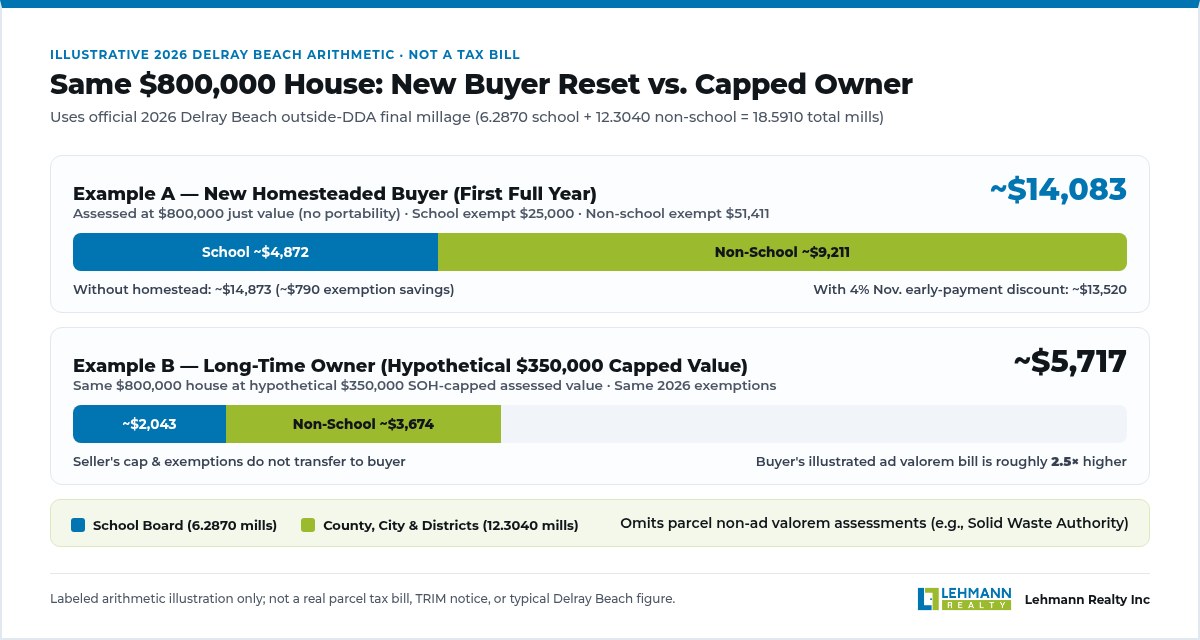
Buyers in Palm Beach County are often surprised when their first full tax year comes in far higher than the seller’s tax bill. On the same $800,000 Delray Beach house in an illustrative 2026 comparison, a new homesteaded buyer assessed at market value owes roughly $14,083 in ad valorem taxes before any early-payment discount, compared with about $5,717 for a long-time owner at a hypothetical $350,000 Save Our Homes-capped assessed value — roughly 2.5 times as much.[1][2]
Do not budget from the seller’s current tax bill, last year’s taxes, or an uncapped listing estimate. The jump happens because Florida’s assessment caps and personal exemptions belong to the prior owner’s tax year and reset to just value on the next January 1 after a change of ownership.[3][4]
This is general information, not legal or tax advice. The Palm Beach County Property Appraiser sets property values and exemptions; the Tax Collector bills and collects taxes; each taxing authority sets its own millage rate. Worked examples below are illustrative arithmetic from official 2026 millage and labeled example values, not a tax bill, a quote, or a typical Delray Beach figure, and they omit non-ad valorem assessments that appear on real bills. Confirm a specific parcel with the Property Appraiser (Exemption Services: 561-355-2866) and, for billing or payment questions, the Tax Collector (561-355-2264), and consult a qualified tax professional.
How a Palm Beach County property tax bill is built (and who does what)
Florida levies no state property tax; all real property taxes are local. As the Palm Beach County Tax Collector summarizes the chain, three numbers sit on every tax roll:[5][6]
- Market value (just value): the Property Appraiser’s estimate of what the property would sell for on January 1 under willing-buyer, willing-seller criteria (section 193.011, Florida Statutes).[7]
- Assessed value: market value minus any Save Our Homes or non-homestead assessment-cap reduction.[6]
- Taxable value: assessed value minus any approved exemptions (such as homestead, senior, veteran, disability, or widow/widower exemptions).[6]
Each local taxing authority — Palm Beach County, the School Board, the municipality (if inside city limits), and special districts — sets a millage rate, where 1 mill equals $1 of tax per $1,000 of taxable value. Because Florida’s additional homestead exemption does not apply to school levies, school and non-school taxable values are calculated separately:[6][8]
- 2026 standard homestead exemption: $25,000 off assessed value for all levies (including school taxes), plus an inflation-indexed additional exemption on assessed value above $50,000 for non-school levies only. Under the Florida Department of Revenue’s CPI table, that 2026 additional exemption is $26,411 (a 2.7% CPI increase from $25,722 in 2025), for a total 2026 non-school homestead exemption of $51,411, while the school exemption stays $25,000. (As of November 23, 2026, the Department of Revenue has not yet published 2027 indexed exemption figures.)[8]
A real tax bill also includes non-ad valorem assessments — unit- or parcel-based charges such as Solid Waste Authority fees — that sit outside the `taxable value × millage` formula and are not reduced by the homestead exemption. In Palm Beach County’s division of roles:[5][9]
- Property Appraiser: values parcels, applies caps and exemptions, and mails August TRIM notices.
- Taxing authorities: adopt budgets and millage rates after public hearings.
- Tax Collector: mails tax bills (more than 600,000 a year) on November 1 and collects payments.
- Value Adjustment Board (VAB): hears formal valuation and exemption petitions.
Why the buyer’s bill resets after a sale
Four rules explain why a new buyer’s second calendar year often looks nothing like the seller’s bill:
1. Assessment and exemption status are fixed on January 1. Under section 192.042(1), real property is assessed as of January 1 each year, and homestead eligibility under section 196.031(1)(a) is also tested as of January 1. Closing mid-year does not rewrite the current year’s assessment or transfer the seller’s exemption onto the current year’s bill. Instead, the buyer and seller settle the closing year through a tax proration in the purchase contract (typically under Standard K of the standard Florida Realtors/Florida Bar contract — see Seller Closing Costs in Palm Beach County).[4][10]
2. Homestead Save Our Homes resets to just value. After a homeowner’s first homestead year, Save Our Homes caps annual assessed-value growth at the lower of 3% or the prior-year CPI change (2.7% for 2026; the 2027 cap has not been published as of November 23, 2026). Even in a flat or falling market, assessed value can still rise by up to the cap until it catches up to just value (“recapture”). When the home sells, section 193.155(3)(a) requires the property to be assessed at just value as of January 1 of the year following the change of ownership (subject to narrow statutory exceptions such as certain spouse or death transfers, or the buyer’s own Florida portability).[3][11]
3. Non-homestead properties also reset — and converting an existing home resets the cap too. Second homes, investment rentals, and commercial or multi-unit properties have separate assessment-increase caps on non-school levies only (school levies have no 10% or 5% assessment cap):[12]
- Section 193.1554 covers non-homestead residential property with 9 or fewer units (including single-family rentals and second homes).
- Section 193.1555 covers nonresidential property and residential property with 10 or more units, and also resets the property to just value as of the next January 1 after a qualifying improvement (a substantially completed improvement that increases just value by at least 25%).
Under both statutes, the non-school cap has been 10% per year and resets to just value on the January 1 following a change of ownership or control (with specific statutory rules for entity ownership). Beginning January 1, 2027, Amendment 3 lowers the non-homestead assessment cap from 10% to 5% on non-school levies under the amended constitutional text (2026 bills are unaffected). In addition, the Palm Beach County Property Appraiser warns that if an owner already holds a non-homestead property and applies for homestead on it, the homestead application itself resets assessed value to market value and removes prior 10%-cap savings — confirm that consequence with Exemption Services before converting a second home or rental.[12][13][14]
4. Seller exemptions stay with the seller’s tax year. A seller’s homestead, senior, veteran, or other personal exemption never carries forward to the buyer. A new owner who qualifies must file for homestead (Form DR-501) by March 1 of the first qualifying tax year.[15]
A February 1, 2027 rule on listing tax displays. Under section 689.261(3), Florida Statutes, effective February 1, 2027, any Florida residential property visible on a public-facing listing platform (excluding social media platforms defined in s. 501.2041(1)) must either display an estimated ad valorem tax calculated from the listing price using a permitted method — the Department of Revenue’s formula and data with required disclaimers, or the countywide aggregate average millage rate with required disclaimers and a link to the Property Appraiser — or omit the estimate, refrain from showing the current owner’s or prior year’s taxes, and link to the Property Appraiser’s tax estimator or homepage. Printed listing materials are also barred from including the current owner’s ad valorem taxes. The Florida Department of Revenue is directed to publish the formula and county average millage inputs beginning December 15, 2026.[16]
2026 Palm Beach County millage rates: why city and district matter
A buyer looking across Palm Beach County does not face one tax rate. Municipal operating rates, debt rates, Downtown Development Authorities, and unincorporated Municipal Service Taxing Units (MSTUs) create wide differences from one parcel to the next. For a walkthrough of how a parcel control number shows city versus unincorporated boundaries in the Delray Beach area, see Delray Beach City vs. Unincorporated Palm Beach County.[1]
The table below lists official 2026 final millage rates from the Palm Beach County Property Appraiser’s final millage schedule (per $1,000 of taxable value):[1]
| Taxing authority (2026 final) | Millage rate | Notes |
|---|---|---|
| Palm Beach County (Operating / Debt) | 4.5000 / 0.0210 | Countywide (4.5210 combined) |
| School Board — Required Local Effort (RLE) | 3.0390 | School levy ($25k exemption only) |
| School Board — Local (Discretionary / Capital / Voted) | 3.2480 | School levy (6.2870 school total) |
| Children’s Services Council | 0.4908 | Countywide special district |
| Health Care District | 0.6561 | Countywide special district |
| South Florida Water Management District (District / Okeechobee / Everglades) | 0.0948 / 0.1026 / 0.0327 | 0.2301 combined (verify parcel district) |
| Florida Inland Navigation District (FIND) | 0.0270 | Countywide special district |
| County Fire/Rescue MSTU | 3.4581 | Unincorporated PBC and participating cities |
| County Library MSTU | 0.5491 | Unincorporated PBC and participating cities |
| City of Delray Beach (Operating / Debt) | 6.3501 / 0.0289 | 6.3790 city total |
| Delray Beach Downtown Development Authority (DDA) | 1.0000 | Applies only inside the DDA boundary |
| Contrast — City of Boca Raton (Op / Debt) + Greater Boca Beach & Park | 3.6476 / 0.0163 + 1.0331 | ~16.909 illustrative city total |
| Contrast — Town of Palm Beach | 2.6110 | ~14.823 illustrative town total |
| Contrast — City of Boynton Beach | 7.2052 | — |
| Contrast — City of West Palm Beach (Op / Debt) | 8.0803 / 0.0533 | — |
Summing the Delray Beach lines with the countywide, school, and water/navigation levies yields 18.5910 mills outside the Delray Beach DDA (6.2870 school + 12.3040 non-school) and 19.5910 mills inside the DDA. By contrast, an unincorporated Palm Beach County parcel adding the Fire/Rescue and Library MSTUs totals about 16.2192 mills. Because these illustrative sums have not been checked against a real parcel’s TRIM notice or tax bill (which can include parcel-specific districts and non-ad valorem fees), confirm any actual address on the Property Appraiser’s parcel search or Property Tax Calculator.[1]
Illustrative worked examples — labeled arithmetic, not a tax bill
The examples below hold official 2026 Delray Beach final millage outside the DDA (6.2870 school / 12.3040 non-school / 18.5910 total) constant and omit non-ad valorem assessments. They are arithmetic illustrations only, not a real tax bill or a typical Delray Beach figure.[1][2]
- Example A — $800,000 Delray Beach house, new homesteaded buyer (assessed value = just value of $800,000, no portability):
- School: ($800,000 − $25,000) × 6.2870 ÷ 1,000 ≈ $4,872
- Non-school: ($800,000 − $25,000 − $26,411) × 12.3040 ÷ 1,000 ≈ $9,211
- Ad valorem total before discounts ≈ $14,083 (compared with $14,873 without homestead — a $790 exemption savings, matching PAPA’s “generally $750 to $1,000” statement).
- With the 4% November early-payment discount (not automatic; applies when paid in November on billed tax), $14,083 drops by about $563 to roughly $13,520.
- Example B — Same $800,000 house, long-time owner at a hypothetical $350,000 Save Our Homes-capped assessed value:
- School: ($350,000 − $25,000) × 6.2870 ÷ 1,000 ≈ $2,043
- Non-school: ($350,000 − $51,411) × 12.3040 ÷ 1,000 ≈ $3,674
- Ad valorem total ≈ $5,717 — making the new buyer’s bill roughly 2.5 times higher on the exact same house.
- Example C — Mid-year closing timing (for example, a June 2026 closing):
- The 2026 tax bill mailed November 1, 2026 reflects January 1, 2026 status (the seller’s assessed value and any seller exemptions) and is settled between buyer and seller at closing through proration.
- The buyer’s just-value reset and any timely March 1, 2027 homestead application apply for 2027, appear first on the August 2027 TRIM notice, and are billed on the November 1, 2027 tax bill.
- For financed purchases, lender escrow payments typically adjust after the higher tax bill or new assessment is reflected in an escrow analysis; escrow timing and adjustment schedules are governed by the loan servicer, not the Property Appraiser or Tax Collector.
Illustrative Amendment 3 comparison (increased track only; 2026 millage and values held constant): Under Amendment 3’s increased non-school exemption ($150,000 in 2027; $250,000 in 2028), Example A drops to roughly $12,870 (2027) and $11,640 (2028), while Example B drops to roughly $4,504 (2027) and $3,274 (2028). A buyer on the new-resident track does not receive those increased figures until the fifth year of exemption, and actual 2027–2028 bills will reflect future millage and market values.[13][14]
Your first-year Palm Beach County tax calendar
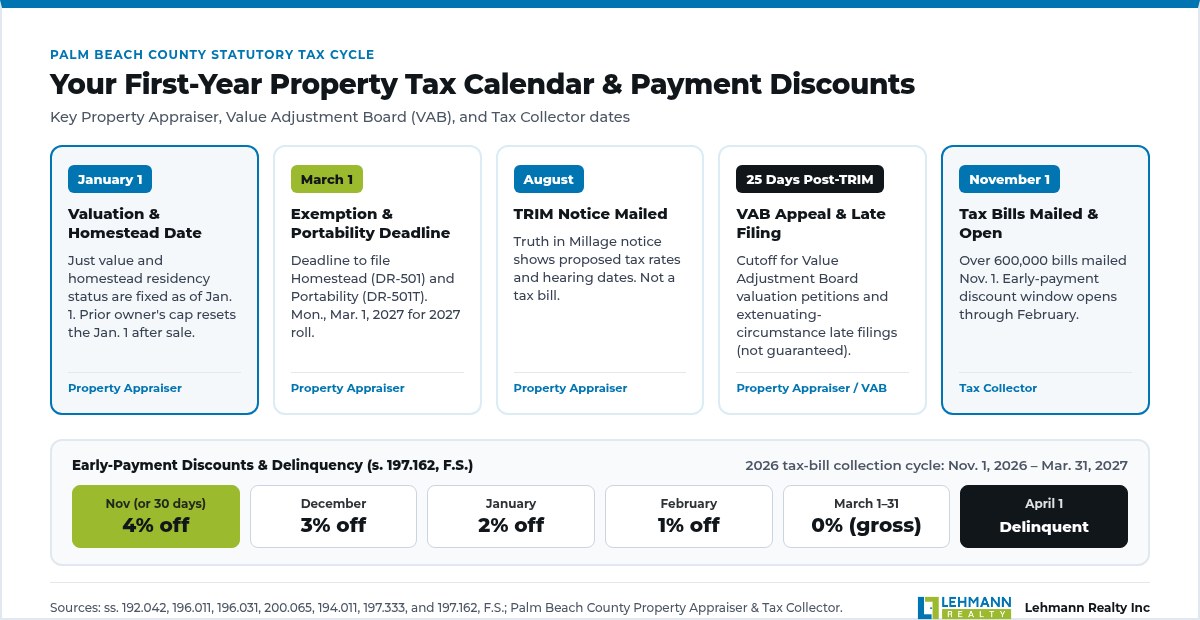
Palm Beach County follows a strict annual cycle set by Florida statute:[15][17][18]
| Date / Window | What happens | Agency / Rule |
|---|---|---|
| January 1 | Valuation and homestead status date | Property Appraiser (ss. 192.042, 196.031) |
| March 1 (Mon., Mar. 1, 2027 for 2027 roll) | Deadline to file Homestead (DR-501) and Portability (DR-501T) | Property Appraiser (s. 196.011(1)(a)) |
| August | TRIM (Truth in Millage) Notice mailed with proposed rates and public hearing dates — not a tax bill | Property Appraiser (s. 200.065) |
| 25 days after TRIM mailing (Sept. 14, 2026 for 2026) | Deadline for Value Adjustment Board (VAB) valuation petition and late homestead filing under s. 196.011(9) (in person, extenuating circumstances, not guaranteed) | Property Appraiser / VAB (s. 194.011; s. 196.011(9)) |
| November 1 | Tax bills mailed (600,000+ bills) and taxes open for payment | Tax Collector (s. 197.333) |
Notice that a TRIM notice explains how much the proposed tax bill would be compared with a “rolled-back rate” (the rate that would raise the same total property tax revenue as the prior year on existing properties). An informal conversation with the Property Appraiser does not extend the 25-day VAB appeal deadline.[17]
Early-payment discounts and delinquency (section 197.162, Florida Statutes):[18]
- November (or within 30 days of mailing): 4% discount
- December: 3% discount
- January: 2% discount
- February: 1% discount
- March (through March 31): 0% (gross amount)
- April 1: taxes become delinquent (statutory penalties and interest apply; the Palm Beach County Tax Collector notes that delinquent real estate taxes cannot be paid online). If the last day of a discount period or March 31 falls on a weekend or legal holiday, the deadline extends to the next working day under section 197.162(4). Note that the Tax Collector’s 2026 calendar also lists early-2026 dates for the prior 2025 tax roll (such as March 31, 2026); the current 2026 tax-bill collection cycle runs November 1, 2026 through March 31, 2027.[5][18]
Portability and Amendment 3: what else can change the math
Two provisions can soften — or delay — the first-year reset depending on where a buyer is moving from:
- Portability up to $500,000: A homeowner moving from another Florida homestead held as of January 1 of any of the 3 immediately preceding years can transfer up to $500,000 of Save Our Homes assessed-value difference by filing Form DR-501T with Form DR-501 by March 1 (proportional scaling applies when downsizing). Effective July 1, 2026 for the 2027 tax roll, Chapter 2026-239 (HB 7031-E) removes the requirement that the prior homestead be the “immediate” prior homestead in that three-year window. See the companion Save Our Homes and portability guide for formulas and examples.[3][19]
- Amendment 3 (effective January 1, 2027): Certified November 17, 2026 with 61.98% of the vote, Amendment 3 increases the non-school homestead exemption to up to $150,000 in 2027 and $250,000 in 2028 (CPI-adjusted starting 2029), keeps the $25,000 school exemption unchanged, keeps Save Our Homes and portability in place, and lowers the non-homestead non-school cap from 10% to 5%. However, owners who homestead on or after January 1, 2027 and “had not maintained a permanent residence in this state as of December 31, 2026” remain on the baseline exemption ($25,000 school and up to $50,000 non-school in the constitutional text, CPI-indexed starting 2028) until “beginning with the fifth year of exemption, to the extent permitted by the U.S. Constitution.” Because no implementing statute has been enacted as of November 23, 2026, how December 31, 2026 residency is proven, how the “fifth year of exemption” is counted, and how the 2027 new-resident non-school dollar amount is set remain pending and unsettled (legislative leaders have pointed in news reports to the March 2, 2027 regular session rather than a special session, and PAPA notes the provisions are subject to federal constitutional requirements and potential legal challenges). See Amendment 3 Certified as Passed and Buying Before Year-End? Two Homestead Tests Matter.[13][14][20]
Quick questions
Does the buyer’s property tax bill change immediately at closing?
No. The closing-year bill reflects January 1 ownership and exemptions and is prorated between buyer and seller at closing. The reassessment to just value happens on the following January 1, appears on the August TRIM notice, and is billed November 1.[4][10][18]
Does a new buyer inherit the seller’s homestead or Save Our Homes cap?
No. The seller’s exemptions and Save Our Homes cap end for that property after the sale; assessed value resets to just value on the next January 1 unless the buyer qualifies for Florida portability.[3][15]
What is the 2026 Florida homestead exemption amount?
$25,000 off assessed value for all taxes including school levies, plus $26,411 (per the Department of Revenue’s 2026 CPI table) off non-school taxes on assessed value above $50,000 — a $51,411 total non-school exemption in 2026. The 2027 indexed amounts have not been published yet.[8] For filing steps and deadlines, see the Palm Beach County homestead exemption guide.
Is a non-homestead property (second home or rental) capped, and does it reset on sale?
Yes. Non-homestead property has a cap on non-school levies only (10% in 2026 under ss. 193.1554 and 193.1555; lowered to 5% effective January 1, 2027 by Amendment 3), and assessed value resets to just value on January 1 after a change of ownership or control.[12][13]
What happens if an owner converts an existing second home or rental to a homestead?
According to the Palm Beach County Property Appraiser, homesteading a property already owned resets the assessed value to market value and removes prior 10%-cap savings. Confirm with Exemption Services before applying.[14]
When are Palm Beach County tax bills mailed, and what are the discounts?
Bills are mailed November 1. Early-payment discounts are 4% in November, 3% in December, 2% in January, and 1% in February; March is gross; taxes become delinquent April 1.[5][18]
What is the difference between a TRIM notice and a tax bill?
The August TRIM notice shows proposed tax rates, values, and public hearing dates (and triggers a 25-day deadline to file a VAB appeal). It is not a bill; the Tax Collector mails the actual tax bill on November 1.[17][18]
What is the homestead filing deadline in Palm Beach County?
March 1 (Monday, March 1, 2027 for the 2027 tax roll). Late applications under s. 196.011(9) are accepted in person within 25 days of TRIM mailing only for documented extenuating circumstances and are not guaranteed.[15]
This is general information, not legal or tax advice. Assessments and exemptions are set by the Palm Beach County Property Appraiser, millage by local taxing authorities, and tax bills by the Palm Beach County Tax Collector; Amendment 3 administration details remain unsettled as of November 23, 2026. Worked figures are illustrative arithmetic from official 2026 rates and labeled values, omitting non-ad valorem fees. Confirm any parcel with the Property Appraiser (561-355-2866) or Tax Collector (561-355-2264), and consult a qualified tax professional.
Get Lehmann Terms, our free Delray Beach real estate newsletter. Subscribe here.
— K
Kurt Lehmann, Florida Real Estate Broker, BK3176578 / Lehmann Realty Inc, Florida real estate brokerage, CQ1039474 / 111 SE 2nd Street, Suite 102, Delray Beach, FL 33444 / LehmannFlorida.com / Equal Housing Opportunity.
Sources
- Palm Beach County Property Appraiser, 2026 Final vs Proposed Millage Rates, https://pbcpao.gov/pdf/taxroll/2026%20Final%20vs%20Proposed%20Millage%20Rates.pdf; Property Tax Calculator, https://pbcpao.gov/calc-property-tax.htm (accessed November 23, 2026).
- Illustrative arithmetic using official 2026 Delray Beach final millage (outside DDA: 6.2870 school + 12.3040 non-school = 18.5910 total), DOR 2026 exemption bands, and labeled hypothetical values; non-ad valorem assessments omitted.
- s. 193.155(1), (3)(a), (8), F.S. (2026), https://www.flsenate.gov/Laws/Statutes/2026/193.155 (accessed November 23, 2026); Florida Department of Revenue, Save Our Homes Assessment Limitation Cap table (revised January 2026), https://floridarevenue.com/property/Documents/SaveOurHomes.pdf (accessed November 23, 2026).
- s. 192.042(1), F.S. (2026), https://www.flsenate.gov/Laws/Statutes/2026/192.042; s. 196.031(1)(a), F.S. (2026), https://www.flsenate.gov/Laws/Statutes/2026/196.031 (accessed November 23, 2026).
- Fla. Const. Art. VII §1(a), §9, https://www.flsenate.gov/Laws/Constitution; Palm Beach County Tax Collector, Property Tax, https://www.pbctax.gov/taxes/property-tax/ (accessed November 23, 2026).
- Palm Beach County Tax Collector, Florida Property Tax Amendment 3 White Paper (September 2026), https://www.pbctax.gov/wp-content/uploads/2026/09/Florida-Property-Tax-Amendment-3-White-Paper_09-2026_FINAL.pdf (accessed November 3, 2026).
- s. 193.011, F.S. (2026), https://www.flsenate.gov/Laws/Statutes/2026/193.011; Fla. Const. Art. VII §4, https://www.flsenate.gov/Laws/Constitution (accessed November 23, 2026).
- Florida Department of Revenue, Additional Homestead Exemption Adjustment (CPI table, revised January 2026), https://floridarevenue.com/property/Documents/cpi_homestead_exemption.pdf; PT-113 Homestead Exemption, https://floridarevenue.com/property/Documents/pt113.pdf (accessed November 23, 2026).
- Palm Beach County Property Appraiser, Homestead Exemption, https://pbcpao.gov/homestead-exemption.htm; Florida Department of Revenue, PT-112, https://floridarevenue.com/property/Documents/pt112.pdf (accessed November 23, 2026).
- Florida Realtors / Florida Bar “AS IS” Residential Contract, Standard K (public copy), https://www.floridarealtors.org/sites/default/files/2024-08/FloridaRealtors-FloridaBar-ASIS-6xx%5B2%5D.pdf (accessed November 20, 2026).
- Florida Department of Revenue, PT-112 Save Our Homes and Portability, https://floridarevenue.com/property/Documents/pt112.pdf (accessed November 3, 2026).
- ss. 193.1554 and 193.1555, F.S. (2026), https://www.flsenate.gov/Laws/Statutes/2026/193.1554; https://www.flsenate.gov/Laws/Statutes/2026/193.1555 (accessed November 23, 2026).
- Florida Division of Elections, Florida Election Watch, Official Election Results, https://floridaelectionwatch.gov/Amendments; Official Amendment 3 ballot text, https://flelectionfiles.floridados.gov/enightfilespublic/20261103_Amendment_03_english.pdf (accessed November 23, 2026).
- Palm Beach County Property Appraiser, Amendment 3 FAQ and Calculator, https://pbcpao.gov/Property/Amendment3Calculator (accessed November 23, 2026).
- s. 196.011(1)(a), (9), F.S. (2026), https://www.flsenate.gov/Laws/Statutes/2026/196.011; Form DR-501, https://floridarevenue.com/property/Documents/dr501.pdf; Palm Beach County Property Appraiser, Exemption Services, https://pbcpao.gov/departments/exemption.htm (accessed November 23, 2026).
- s. 689.261(3), F.S. (2026), https://www.flsenate.gov/Laws/Statutes/2026/0689.261 (accessed November 23, 2026).
- s. 200.065, F.S. (2026), https://www.flsenate.gov/Laws/Statutes/2026/200.065; s. 194.011, F.S. (2026), https://www.flsenate.gov/Laws/Statutes/2026/194.011; Palm Beach County Property Appraiser, File a Petition, https://pbcpao.gov/file-petition.htm (accessed November 23, 2026).
- ss. 197.333 and 197.162, F.S. (2026), https://www.flsenate.gov/Laws/Statutes/2026/197.333; https://www.flsenate.gov/Laws/Statutes/2026/197.162 (accessed November 23, 2026).
- Palm Beach County Property Appraiser, Portability, https://pbcpao.gov/portability.htm; Form DR-501T, https://floridarevenue.com/property/Documents/dr501t.pdf; Florida Department of Revenue, Bulletin PTO 26-07 (July 13, 2026), https://floridarevenue.com/property/Documents/PTO_BUL_26-07.pdf; Ch. 2026-239, Laws of Florida (HB 7031-E), https://laws.flrules.org/2026/239 (accessed November 23, 2026).
- Fla. Const. Art. III §3(b), https://www.flsenate.gov/Laws/Constitution; legislative-session timing reported on November 17, 2026 (secondary sources): CBS Miami, https://www.cbsnews.com/miami/news/florida-legislative-leaders-amendment-3-special-session-regular-session-boyd-garrison-desantis/; Florida Phoenix, https://floridaphoenix.com/2026/11/17/new-house-and-senate-leaders-see-amendment-3-as-major-challenge-next-year/.