

By Kurt Lehmann, Lehmann Realty Inc
In Florida, a long-time homeowner’s property tax bill often reflects years of capped assessment growth rather than what the home would sell for today. When that home sells, the seller’s exemptions and Save Our Homes cap do not transfer to the buyer. On the same $800,000 Delray Beach house in an illustrative 2026 example, a new homesteaded buyer assessed at market value owes roughly $14,083 in ad valorem taxes, compared with about $5,717 for a long-time owner at a hypothetical $350,000 capped assessed value.[1][2]
For a Florida homeowner who plans to buy another primary residence in the state, portability is the mechanism that lets part or all of that accumulated Save Our Homes gap move to the next Florida home. A separate companion guide in this series covers why property taxes change after a purchase in Palm Beach County and how the first-year billing calendar works; this article covers homestead eligibility, Save Our Homes, portability math, and how Amendment 3 interacts with them.[1][3]
This is general information, not legal or tax advice. The Palm Beach County Property Appraiser decides who qualifies for homestead, Save Our Homes, and portability. Amendment 3 takes effect January 1, 2027; some administration details are not final. Worked examples are illustrative arithmetic from official 2026 Delray Beach millage and labeled example values, not a tax bill, a quote, or a promise about any parcel. Confirm a specific property with the Property Appraiser’s Exemption Services (561-355-2866) and consult a qualified tax professional before planning a closing or a move around these dates.
How the Florida homestead exemption works (2026 rules)
Florida property tax starts with January 1. Real property is assessed at just value as of January 1 each year, and homestead eligibility is decided as of that same date. Under section 196.031(1)(a), Florida Statutes, a person who, on January 1, holds legal title or beneficial title in equity to real property in Florida and in good faith makes the property his or her permanent residence (or the permanent residence of a legal or natural dependent) qualifies for homestead, provided the deed or instrument is recorded in the county’s official records before the exemption is granted.[4][5]
A person receiving a residency-based property tax exemption or credit in another state — the Palm Beach County Property Appraiser lists Rollback, STAR, Enhanced STAR, and abatements as examples — is not entitled to Florida homestead, subject to a narrow statutory exception when the Florida property is the permanent residence of a dependent. Confirm any out-of-state tax benefit with the Property Appraiser before applying.[5][6]
For 2026, the standard Florida homestead exemption has two stacked parts:[5][7]
- $25,000 off assessed value for all levies, including school district taxes.
- An additional inflation-indexed exemption on assessed value above $50,000 for non-school levies only. Under the Florida Department of Revenue’s CPI adjustment table, that additional exemption rose from $25,000 in 2024 to $25,722 in 2025 and $26,411 in 2026 (a 2.7% CPI increase). That makes the total 2026 non-school exemption $51,411, while the school exemption remains $25,000. (As of November 23, 2026, the Department of Revenue has not yet published 2027 CPI-adjusted figures.)[7]
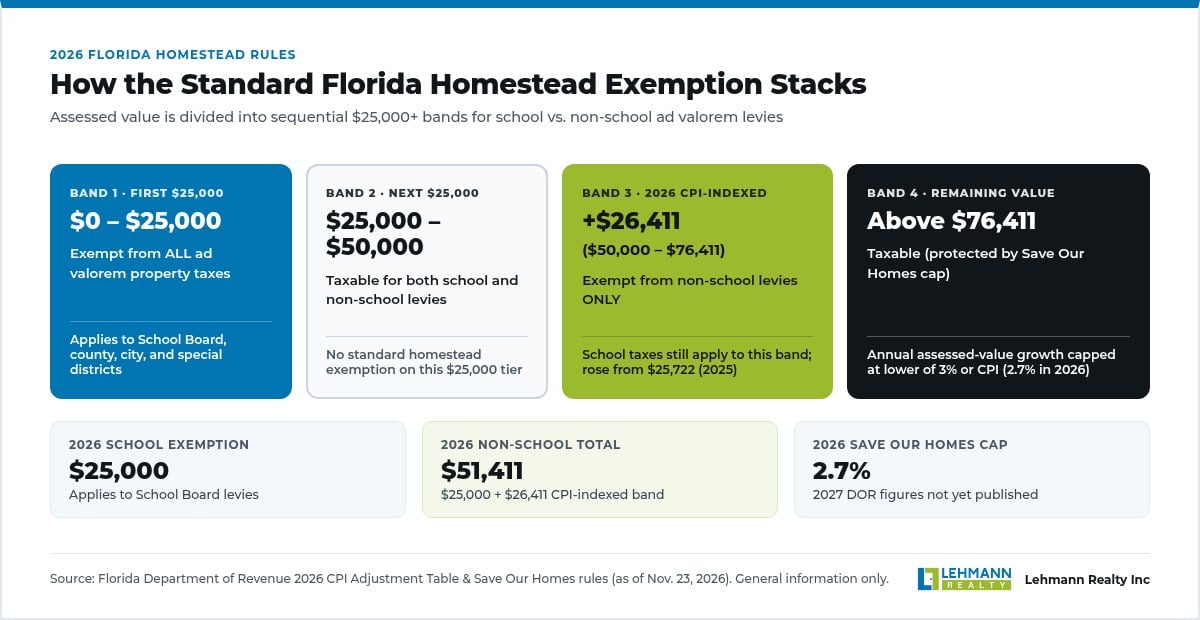
As explained by the Department of Revenue, those bands stack sequentially: the first $25,000 of assessed value is exempt from all ad valorem taxes; the next $25,000 is taxable; the third band ($26,411 in 2026) is exempt from non-school taxes only; and any assessed value above that is taxable. In Palm Beach County, the Property Appraiser states that a homestead exemption “can save you generally $750 to $1,000 in property taxes each year” under existing rules — a general range for the exemption itself, separate from Save Our Homes savings.[6][8]
For filing steps and deadlines, see the Palm Beach County homestead exemption guide.
Filing and deadlines in Palm Beach County. Homestead is filed with the Property Appraiser, not the Tax Collector, by March 1 of the tax year for which the exemption is sought. Missing March 1 constitutes a waiver for that year under s. 196.011(1)(a), unless an exception applies. For the 2027 tax roll, closing, recording, and making the home a permanent residence by January 1, 2027 (practically, by December 31, 2026) pairs with a filing deadline of Monday, March 1, 2027. A mid-year buyer does not put homestead on the current year’s tax bill; that bill reflects January 1 status, usually the seller’s, and the buyer applies for the next year. For more on year-end timing, see Buying Before Year-End? Two Homestead Tests Matter.[6][9]
Applications in Palm Beach County can be submitted by E-File, in person at one of five service centers (including the South County Service Center at 14925 Cumberland Drive, Delray Beach, FL 33446, 561-276-1250), or by mailing Form DR-501. The Property Appraiser’s checklist requires Social Security numbers for applying owners and spouses (an otherwise timely application missing Social Security numbers may be completed by April 1), a valid Florida driver license or Florida ID, proof of permanent residency if not a U.S. citizen, and one supporting residency item such as Florida vehicle registration, Florida voter registration matching the address, a Declaration of Domicile, a federal tax return, or utility bills for the property. Once granted, homestead renews automatically (a pink-and-white receipt card is mailed on the last business day of December), and owners must report changes such as a sale, marriage, divorce, death, or rental/change in use. Homestead does not automatically follow a move to a new house; a new application is required.[6][9]
If March 1 is missed, Florida law provides a limited late-filing path under section 196.011(9) (not subsection (8), which governs documented postal errors): a qualified applicant may file on or before the 25th day after the Property Appraiser mails the August TRIM notices, but must show inability to file timely or extenuating circumstances. The Property Appraiser asks late filers to apply in person and describes the cutoff as mid-September; late approval is not guaranteed, and a denial can be petitioned to the Value Adjustment Board (with a $15 filing fee).[9][10]
Tax homestead under Article VII of the Florida Constitution is also separate from Florida’s forced-sale creditor protection and devise-and-descent restrictions under Article X, Section 4. The Property Appraiser administers only the property-tax exemption and does not determine Article X title, inheritance, or creditor protections; for questions on how those constitutional rules affect your own deed or estate plan, consult your own Florida real estate or estate attorney.[11]
The Save Our Homes cap — and why a sale resets it
Beginning the year after a homestead exemption is first granted, section 193.155(1) limits annual increases in assessed value to the lower of 3% or the percentage change in the Consumer Price Index (CPI-U, all items) for the preceding calendar year, and assessed value can never exceed just value. Because CPI was below 3% in 2025 and 2026, the cap matched CPI in both years:[12][13]
| Tax year | Prior-year CPI change | Save Our Homes cap (lower of 3% or CPI) |
|---|---|---|
| 2026 | 2.7% | 2.7% |
| 2025 | 2.9% | 2.9% |
| 2024 | 3.4% | 3.0% |
| 2023 | 6.5% | 3.0% |
| 2022 | 7.0% | 3.0% |
The 2027 Save Our Homes cap has not been published yet. As of November 23, 2026, the Department of Revenue’s Save Our Homes chart still ends at 2026 (2.7%). The 2027 cap depends on full-year 2026 CPI-U data and is typically posted by the Department of Revenue in January. Confirm the 2027 percentage once published rather than assuming 2.7% repeats.[13]
One rule surprises many owners in a flat or cooling market: recapture. As the Department of Revenue notes, even if a home’s market value falls, its assessed value can still increase by up to the annual cap until assessed value catches up to just value — though never above just value.[14]
The reset on sale. Except for statutory exceptions and portability, homestead property “shall be assessed at just value as of January 1 of the year following a change of ownership” under section 193.155(3)(a). A change of ownership covers any sale, foreclosure, or transfer of legal or beneficial title, subject to listed statutory exceptions such as certain transfers between spouses, transfers at death, and error-correcting deeds. The seller’s accumulated Save Our Homes cap difference — often called the “SOH benefit” — disappears on that property when it sells, unless the seller ports it to another Florida homestead.[12][14]
How portability works: moving your Save Our Homes savings
Portability allows a Florida homeowner who leaves one homestead and establishes another Florida homestead to transfer the accumulated Save Our Homes assessment difference (just value minus assessed value), up to $500,000. Portability works statewide across county lines — for example, moving between Palm Beach, Broward, and Martin Counties, or anywhere else in Florida — and does not travel out of state.[12][15]
The three-year window uses January 1, not closing dates. Under section 193.155(8), a homeowner qualifies if they received a Florida homestead exemption “as of January 1 of any of the 3 immediately preceding years.” Both the Department of Revenue and the Palm Beach County Property Appraiser stress that the clock runs from January 1, not three years after the closing date. For example, if an owner held homestead as of January 1, 2026 and sold later in 2026, establishing a new Florida homestead as of January 1 of 2027, 2028, or 2029 falls within the three-year window; waiting until January 1, 2030 would fall outside it. A husband and wife who owned and permanently resided on a prior homestead are each treated as having received the exemption even if only one spouse’s name was on the application.[12][14][15]
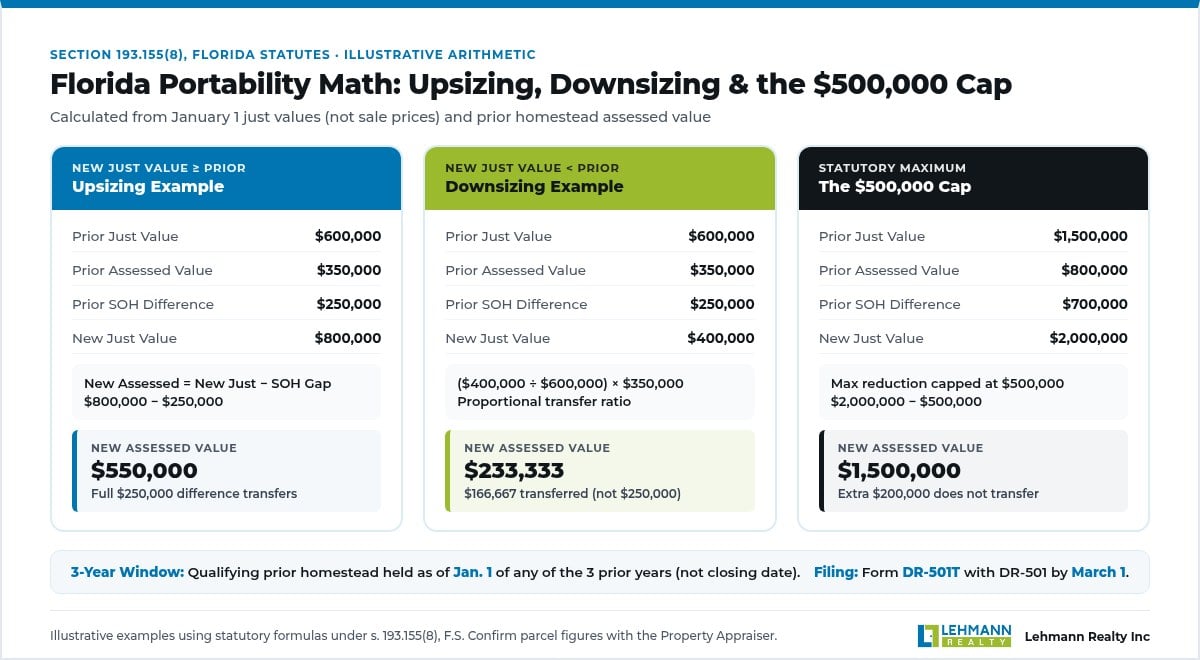
Upsizing versus downsizing formulas. Portability is calculated from just value as of January 1 (not contract sale price) and the prior homestead’s values as of January 1 of the year it was abandoned. The statutory math differs depending on whether the new home has a higher or lower just value:[12]
- Upsizing or equal value (`new just value >= prior just value`, s. 193.155(8)(a)): the new home’s assessed value is reduced by the full Save Our Homes difference (prior just value minus prior assessed value), capped at $500,000.
- Downsizing (`new just value < prior just value`, s. 193.155(8)(b)): the owner transfers a proportional percentage of the difference rather than the full dollar amount. The statute sets `new assessed value = (new just value ÷ prior just value) × prior assessed value`, provided the transferred reduction still cannot exceed $500,000.
Illustrative portability examples (using the statutory formulas):
- PAPA’s published example: Prior home just value $250,000 and assessed value $150,000 (a $100,000 difference). If the new home has a higher just value, its assessed value is reduced by $100,000; if it has a lower just value, a percentage of that difference transfers.[15]
- Upsizing example: Prior homestead had a $600,000 just value and $350,000 assessed value ($250,000 difference). On a new homestead with an $800,000 just value, the new assessed value is $800,000 − $250,000 = $550,000.
- Downsizing example: Using the same prior home ($600,000 just / $350,000 assessed), on a new homestead with a $400,000 just value, the new assessed value is ($400,000 ÷ $600,000) × $350,000 = $233,333 (rounded). The transferred difference is $166,667, not $250,000.
- The $500,000 cap: Prior homestead had a $1,500,000 just value and $800,000 assessed value ($700,000 difference). On a $2,000,000 new homestead, the maximum reduction is $500,000, leaving a $1,500,000 assessed value; the extra $200,000 of difference does not transfer.
Multiple owners and spouses. If two or more people who each held a separate prior homestead establish one joint new homestead together, section 193.155(8)(c) limits the transferred reduction to the higher of the two prior differences (capped at $500,000), not the sum of both. When joint owners of a prior homestead split up, all owners must abandon the prior homestead for a difference to transfer, and spouses may file a Designation of Ownership Shares before applying for portability. Confirm joint-owner facts directly with Exemption Services.[12][15]
Filing Form DR-501T. Portability is not automatic. File Form DR-501T (Transfer of Homestead Assessment Difference) together with the new homestead application (DR-501) by March 1. In Palm Beach County, both can be filed together through the Property Appraiser’s e-file portal, or DR-501T can be filed separately if the new homestead application was already submitted; denials may be appealed to the Value Adjustment Board. The Property Appraiser also provides an online Portability Calculator to model estimates. For sellers planning a 2027 move, see Selling in 2027? Five Things to Handle Before Year-End.[15][16]
A 2027 statutory cleanup on prior homesteads. Effective July 1, 2026 and first applying to the 2027 tax roll, section 3 of Chapter 2026-239 (HB 7031-E) amends s. 193.155(8)(a) and (b) to remove the requirement that the prior homestead used for portability be the owner’s “immediate” prior homestead within the three-year window, aligning the statute with Article VII, Section 4 of the Florida Constitution. Confirm with the Property Appraiser how that change applies if an owner held more than one homestead inside the three-prior-January-1 window.[17]
How Amendment 3 interacts with Save Our Homes and portability
Amendment 3 passed with 61.98% of the vote (60% required) in the November 3, 2026 general election (Yes: 4,922,977; No: 3,020,085; Total: 7,943,062), and the Elections Canvassing Commission certified the official returns on November 17, 2026. The amendment takes effect January 1, 2027. For full election and ballot background, see Amendment 3 Cleared 60% and Has Been Certified as Passed.[18][19]
Save Our Homes and portability stay in place. The Palm Beach County Property Appraiser’s Amendment 3 FAQ states plainly: “Save Our Homes remains in effect,” and “Amendment 3 does not eliminate portability. Eligible homeowners may continue to transfer qualifying Save Our Homes benefits when establishing a new homestead, subject to existing eligibility requirements and deadlines.” Existing homesteaders who already qualify do not need to reapply because of Amendment 3; the change applies automatically beginning with the 2027 tax year, and 2026 tax bills are unaffected (the first appearance is on August 2027 TRIM notices and November 2027 bills).[20]
What Amendment 3 changes in the constitutional text (effective January 1, 2027):[19][20]
- Increased non-school homestead exemption: up to $150,000 beginning January 1, 2027, and up to $250,000 beginning January 1, 2028, adjusted for inflation beginning January 1, 2029, for owners who qualify on the increased track.
- School exemption unchanged: stays up to $25,000. Amendment 3 does not eliminate property taxes and does not cut school taxes or non-ad valorem assessments.
- Non-homestead assessment cap: lowers the annual cap on non-school assessment increases from 10% to 5% beginning January 1, 2027.
- New-resident track: under Article VII, Section 6(a)(1)b., a person who qualifies for homestead on or after January 1, 2027 and “had not maintained a permanent residence in this state as of December 31, 2026” receives up to $25,000 for school levies and up to $50,000 for non-school levies (CPI-adjusted beginning January 1, 2028), with the increased exemption “beginning with the fifth year of exemption, to the extent permitted by the U.S. Constitution.” Counties or cities may, beginning on or after January 1, 2030, shorten that five-year requirement by a two-thirds vote if a “critical local need” is found (none has done so).
Why new-resident and administration rules remain pending/unsettled. As of November 23, 2026, no implementing statute has been enacted, and the Property Appraiser’s FAQ states that all implementation details are not yet known. Several rules remain open:[20]
- How December 31, 2026 permanent residence will be proven. The constitutional text directs the Legislature to prescribe uniform administration procedures by general law; no Amendment 3 proof list has been enacted yet. (The Property Appraiser has noted that a Florida resident as of December 31, 2026 — including a renter — who buys a first home in 2027 may qualify for the increased exemption if eligibility requirements are met and an application is filed.)[20]
- How the “fifth year of exemption” is counted. Statutory rules have not settled how those years are tracked, including whether a gap or a portability move affects the count.
- The 2027 new-resident-track non-school dollar amount. The ballot summary refers to “the existing homestead exemption” ($51,411 in 2026 under the CPI-indexed statute), while the constitutional text states a $50,000 non-school amount indexed beginning in 2028. How 2027 will be computed is not settled.
- Legislative timing and constitutional review. After the November 17 organizational session, legislative leaders indicated in news reports that they expect remaining Amendment 3 issues to be taken up in the 2027 regular session (which convenes March 2, 2027 under Article III, Section 3(b) of the Florida Constitution) rather than a year-end special session, though no implementing law is enacted. Separately, the Property Appraiser cautions that the residency provisions “are subject to federal constitutional requirements and may be affected by future legislation, legal challenges, or court decisions.”[20][21][22]
Portability still applies on top of whichever exemption track a new homestead receives. Confirm current guidance with the Property Appraiser before making timing or moving decisions.
Illustrative Delray Beach arithmetic — example figures only, not a tax bill
The examples below hold official 2026 final Delray Beach millage constant (outside the Downtown Development Authority: 6.2870 school mills + 12.3040 non-school mills = 18.5910 combined mills; inside the DDA, add 1.0000 mill for 19.5910 mills). These figures are illustrative arithmetic from labeled assumptions, not a real parcel’s bill or TRIM notice, and they omit non-ad valorem assessments (such as Solid Waste Authority fees) and early-payment discounts.[2][23]
2026 rules ($800,000 Delray Beach house):
- Example A — new homesteaded buyer, first year (assessed value = just value of $800,000, no portability):
- School: ($800,000 − $25,000) × 6.2870 ÷ 1,000 ≈ $4,872
- Non-school: ($800,000 − $25,000 − $26,411) × 12.3040 ÷ 1,000 ≈ $9,211
- Ad valorem total ≈ $14,083 (without homestead, $800,000 × 18.591 ÷ 1,000 ≈ $14,873, so the 2026 homestead exemption saves roughly $790).
- Example B — same house, long-time owner at a hypothetical $350,000 Save Our Homes-capped assessed value:
- School: ($350,000 − $25,000) × 6.2870 ÷ 1,000 ≈ $2,043
- Non-school: ($350,000 − $51,411) × 12.3040 ÷ 1,000 ≈ $3,674
- Ad valorem total ≈ $5,717. On the same house at 2026 rates, the new buyer in Example A owes roughly 2.5 times what the capped owner pays.
Same Examples A and B under Amendment 3 (increased track only; holding 2026 rates and values constant, which will not happen in practice): A new-track buyer who had not maintained a permanent Florida residence as of December 31, 2026 stays on the existing exemption until the fifth year of exemption and does not receive these 2027–2028 figures.[19]
- At a $150,000 non-school exemption (2027): Example A ≈ $4,872 + $7,998 = $12,870 (about $1,213 less than the 2026 homesteaded illustration); Example B ≈ $2,043 + $2,461 = $4,504.
- At a $250,000 non-school exemption (2028): Example A ≈ $11,640 ($4,872.43 school + $6,767.20 non-school); Example B ≈ $3,274 ($2,043.28 school + $1,230.40 non-school).
Quick questions
What is the Florida homestead exemption in 2026?
$25,000 off assessed value for all taxes including school levies, plus an additional $26,411 off non-school taxes on assessed value above $50,000 (a $51,411 total non-school exemption in 2026, per the Department of Revenue). The 2027 indexed exemption figures have not yet been published by DOR.[7]
What is the 2026 Save Our Homes cap, and has 2027 been set?
The 2026 Save Our Homes cap is 2.7%. The 2027 cap has not been published yet as of November 23, 2026; the Department of Revenue typically posts the next year’s figure after full-year CPI data is released in January.[13]
If a homeowner sells, does Save Our Homes stay on the house or move automatically?
Neither. On the sold house, assessed value resets to just value on January 1 of the year after the change of ownership (unless a statutory exception applies). On the seller’s next Florida home, the owner must apply for both homestead and portability (Form DR-501T) by March 1.[12][15]
How does portability work when buying a cheaper home versus a more expensive one?
When the new home’s just value is equal to or higher than the prior homestead’s just value, the full Save Our Homes difference (up to $500,000) reduces the new assessed value. When the new home’s just value is lower, only a proportional percentage of the difference transfers under s. 193.155(8)(b).[12]
Is the three-year portability window measured from the closing date?
No. The statute requires a Florida homestead exemption as of January 1 of any of the 3 immediately preceding years, not three years from the sale closing date.[12][14]
Can Save Our Homes benefits be ported between Florida counties?
Yes. Portability applies anywhere within Florida — including into or out of Palm Beach County — and cannot be transferred out of state.[15]
Does Amendment 3 eliminate Save Our Homes or portability?
No. The Palm Beach County Property Appraiser confirms that Save Our Homes remains in effect and portability is not eliminated.[20]
If a buyer was not a Florida resident on December 31, 2026, can they still get homestead?
Yes. That December 31, 2026 permanent-residence test affects only the size of the non-school exemption under Amendment 3, not eligibility to apply for homestead under the January 1 and March 1 rules. Specific procedures and counting rules for the new-resident track remain unsettled pending legislation or official guidance.[19][20]
Why is a buyer’s tax estimate much higher than the seller’s current tax bill?
Because the seller’s bill reflects the seller’s capped assessed value and personal exemptions, while the buyer’s assessment resets to just value as of the next January 1 (minus any portability the buyer brings). See the companion guide on why property taxes change after buying in Palm Beach County.[1][12]
This is general information, not legal or tax advice. Homestead eligibility, Save Our Homes caps, and portability amounts are decided by the county Property Appraiser under Florida law, and Amendment 3 administration details remain unsettled as of November 23, 2026. Worked examples use official 2026 Delray Beach millage and hypothetical values for illustration only. Confirm a specific property with the Palm Beach County Property Appraiser’s Exemption Services (561-355-2866) and consult a qualified tax professional.
Get Lehmann Terms, our free Delray Beach real estate newsletter. Subscribe here.
— K
Kurt Lehmann, Florida Real Estate Broker, BK3176578 / Lehmann Realty Inc, Florida real estate brokerage, CQ1039474 / 111 SE 2nd Street, Suite 102, Delray Beach, FL 33444 / LehmannFlorida.com / Equal Housing Opportunity.
Sources
- ss. 192.042, 193.155, and 196.031, F.S. (2026), https://www.flsenate.gov/Laws/Statutes/2026/192.042; https://www.flsenate.gov/Laws/Statutes/2026/193.155; https://www.flsenate.gov/Laws/Statutes/2026/196.031 (accessed November 23, 2026).
- Palm Beach County Property Appraiser, 2026 Final vs Proposed Millage Rates, https://pbcpao.gov/pdf/taxroll/2026%20Final%20vs%20Proposed%20Millage%20Rates.pdf (accessed November 23, 2026); Palm Beach County Tax Authority Codes, https://pbcpao.gov/pdf/taxroll/Palm%20Beach%20County%20Tax%20Auth%20Code.pdf (accessed November 4, 2026).
- Palm Beach County Tax Collector, Property Tax, https://www.pbctax.gov/taxes/property-tax/ (accessed November 23, 2026).
- s. 192.042(1), F.S. (2026), https://www.flsenate.gov/Laws/Statutes/2026/192.042; s. 196.031(1)(a), F.S. (2026), https://www.flsenate.gov/Laws/Statutes/2026/196.031 (accessed November 23, 2026).
- s. 196.031(1), (6), F.S. (2026), https://www.flsenate.gov/Laws/Statutes/2026/196.031; Fla. Const. Art. VII §6, https://www.flsenate.gov/Laws/Constitution (accessed November 23, 2026).
- Palm Beach County Property Appraiser, Homestead Exemption, https://pbcpao.gov/homestead-exemption.htm (accessed November 23, 2026).
- Florida Department of Revenue, Additional Homestead Exemption Adjustment (CPI table, revised January 2026), https://floridarevenue.com/property/Documents/cpi_homestead_exemption.pdf (accessed November 23, 2026).
- Florida Department of Revenue, PT-113 Homestead Exemption, https://floridarevenue.com/property/Documents/pt113.pdf (accessed November 3, 2026).
- s. 196.011(1)(a)–(b), (8)–(9), F.S. (2026), https://www.flsenate.gov/Laws/Statutes/2026/196.011; Form DR-501, https://floridarevenue.com/property/Documents/dr501.pdf (accessed November 23, 2026).
- Palm Beach County Property Appraiser, Exemption Services, https://pbcpao.gov/departments/exemption.htm (accessed November 23, 2026).
- Fla. Const. Art. VII §6; Art. X §4, https://www.flsenate.gov/Laws/Constitution (accessed November 23, 2026).
- s. 193.155(1)–(3)(a), (8), F.S. (2026), https://www.flsenate.gov/Laws/Statutes/2026/193.155 (accessed November 23, 2026).
- Florida Department of Revenue, Save Our Homes Assessment Limitation Cap table (revised January 2026), https://www.floridarevenue.com/property/Documents/SaveOurHomes.pdf (accessed November 23, 2026).
- Florida Department of Revenue, PT-112 Save Our Homes and Portability, https://floridarevenue.com/property/Documents/pt112.pdf (accessed November 3, 2026).
- Palm Beach County Property Appraiser, Portability, https://pbcpao.gov/portability.htm; Portability Calculator, https://pbcpao.gov/calc-portability.htm (accessed November 23, 2026).
- Florida Department of Revenue, Form DR-501T, https://floridarevenue.com/property/Documents/dr501t.pdf (accessed November 23, 2026).
- Florida Department of Revenue, Bulletin PTO 26-07 (July 13, 2026), https://floridarevenue.com/property/Documents/PTO_BUL_26-07.pdf; Ch. 2026-239, Laws of Florida (HB 7031-E), https://laws.flrules.org/2026/239; House final bill analysis, https://flsenate.gov/Session/Bill/2026E/7031E/Analyses/h7031z1.WMC.PDF (accessed November 23, 2026).
- Florida Division of Elections, Florida Election Watch, Official Election Results, https://floridaelectionwatch.gov/Amendments (totals as posted November 23, 2026).
- Official Amendment 3 ballot text, Florida Division of Elections, https://flelectionfiles.floridados.gov/enightfilespublic/20261103_Amendment_03_english.pdf (accessed November 23, 2026).
- Palm Beach County Property Appraiser, Amendment 3 FAQ and Calculator, https://pbcpao.gov/Property/Amendment3Calculator (accessed November 23, 2026); Palm Beach County Tax Collector, Florida Property Tax Amendment 3 White Paper (September 2026), https://www.pbctax.gov/wp-content/uploads/2026/09/Florida-Property-Tax-Amendment-3-White-Paper_09-2026_FINAL.pdf (accessed November 3, 2026).
- Fla. Const. Art. III §3(b), https://www.flsenate.gov/Laws/Constitution; legislative-session timing reported on November 17, 2026 (secondary sources): CBS Miami, https://www.cbsnews.com/miami/news/florida-legislative-leaders-amendment-3-special-session-regular-session-boyd-garrison-desantis/; Florida Phoenix, https://floridaphoenix.com/2026/11/17/new-house-and-senate-leaders-see-amendment-3-as-major-challenge-next-year/.
- Constitutional context noted for caution only (not a prediction of litigation outcomes): Hooper v. Bernalillo County Assessor, 472 U.S. 612 (1985); Osterndorf v. Turner, 426 So. 2d 539 (Fla. 1983).
- Examples A and B are illustrative arithmetic computed from the 2026 Delray Beach final millage rates and labeled hypothetical values; non-ad valorem assessments are omitted.